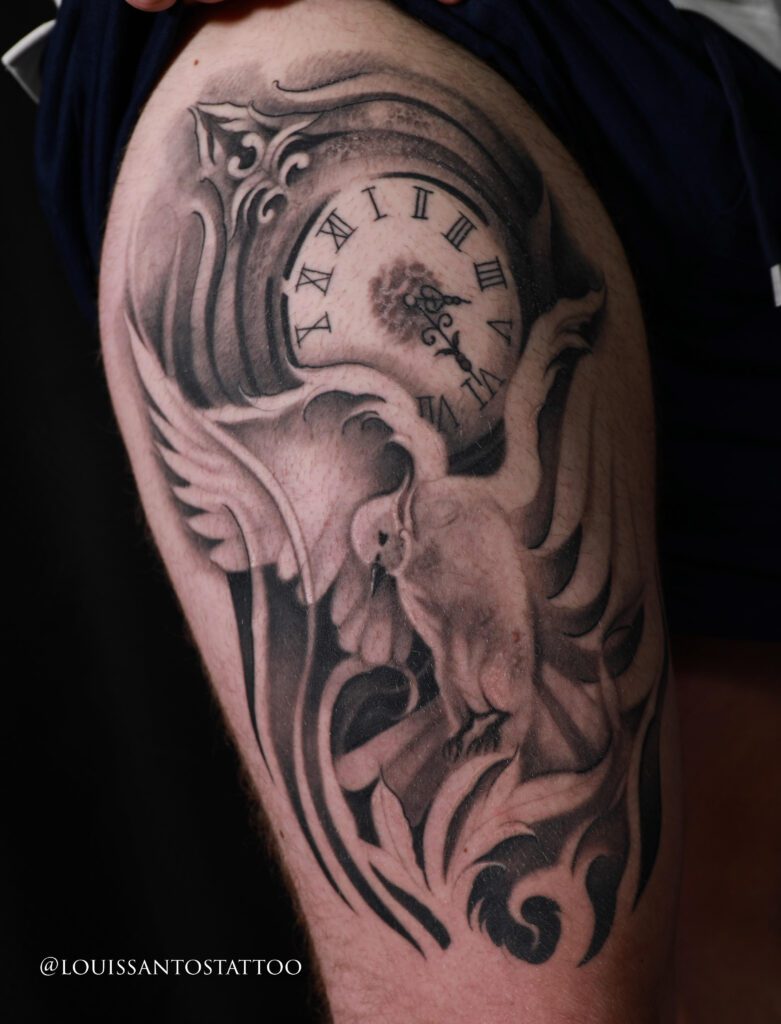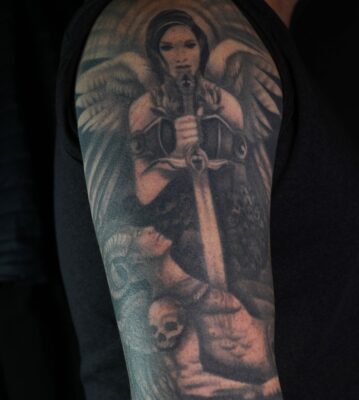

The history of black and grey tattoos is rich, evolving from humble beginnings to becoming one of the most revered styles in the tattoo industry. As a tattoo artist who specializes in black and grey realism, I find this style incredibly rewarding. There’s a timelessness to it, a level of detail and emotion that no other style can quite replicate.
Origins of Black and Grey Tattoos Black and grey tattoos originated in the prisons of California in the 1970s. Inmates, using makeshift tattoo machines made from guitar strings and the motors of cassette players, would tattoo using only black ink. They diluted the black ink with water to create various shades of grey, giving rise to the gradient effect that defines the style. Without access to colored inks, these early tattoos relied on shading and contrast to bring depth and life to their designs. From there, the style spread beyond prisons and into mainstream tattoo culture. Chicano artists, especially in Los Angeles, played a pivotal role in bringing black and grey tattoos into the tattoo parlors. They incorporated cultural themes, like religious iconography, portraits, and street life, into their designs, further expanding the range of subjects that could be tackled in this style.
Evolution of Black and Grey Realism As the art form evolved, black and grey tattoos moved from simple designs to highly detailed works of art. Black and grey realism took the style to a new level, focusing on lifelike portraits, intricate textures, and a depth of shading that can create almost three-dimensional effects on the skin. Advancements in tattooing equipment, ink quality, and technique have allowed artists to create more precise lines, smoother blends, and more complex textures. This has made it possible for black and grey realism to flourish as a dominant style in the industry. In the early 2000s, with the explosion of tattoo TV shows and social media, black and grey realism gained widespread popularity. Artists like Nikko Hurtado, Carlos Torres, and Robert Hernandez became known for their breathtakingly detailed black and grey tattoos, pushing the boundaries of what could be done with just black ink.
Why Black and Grey Realism Is My Favorite Style As an artist, I’m deeply drawn to black and grey realism for its rawness and its emotional impact. There’s something powerful about working with only shades of black and grey—it forces you to focus on the fundamentals: shading, texture, and depth. Each tattoo becomes a challenge, an opportunity to recreate reality on the skin in a way that feels alive and timeless. When I’m working on a portrait, for example, every wrinkle, every shadow, every highlight has to be meticulously placed to bring that person to life. There’s a subtlety in black and grey realism that you don’t always get with color tattoos. You’re not relying on vibrant hues to grab attention—you’re using light and shadow to draw the viewer in. One of the most rewarding aspects of black and grey realism is how versatile it is. Whether it’s a hyper-realistic portrait of a loved one, a mythical creature, or a scene from nature, black and grey realism can handle it. There’s a depth and emotion that this style brings out that is difficult to achieve with any other tattooing technique.