Manchester Tattoo Artist

Zeus, the Greek God of the sky and thunder, stands as one of the most prominent and influential figures in Greek mythology. With his mighty presence and complex personality, Zeus presides over the pantheon of Greek gods and plays a pivotal role in numerous myths and legends that have captivated human imagination for centuries.
Born to Cronus and Rhea, Zeus was the youngest among his siblings, who were swallowed by his father due to a prophecy of one of his offspring overthrowing him. Saved and hidden by Rhea, Zeus grew up in secret and later challenged Cronus, leading to a great war between the Titans and the Olympian gods. Emerging victorious, Zeus claimed dominion over the heavens, becoming the supreme ruler of Mount Olympus and all the gods and goddesses who resided there.
As the god of the sky, Zeus controlled weather phenomena, wielding thunderbolts as symbols of his power and authority. This association earned him the epithet “Zeus Philios” (Zeus the Friendly), as the Greeks believed that his thunderbolts would strike only those he favored or deemed deserving of punishment.
Despite his divine stature, Zeus was not immune to the complexities of human emotions. Renowned for his numerous affairs, he engaged in both consensual and non-consensual relationships with mortals and other deities, siring numerous offspring. Hera, his sister and wife, often bore the brunt of his infidelities, leading to her reputation as the goddess of marriage and jealousy. Nevertheless, Zeus maintained a complicated relationship with Hera, as she was both a victim of his indiscretions and a powerful ally in maintaining order and justice in the world.
Zeus played an essential role in maintaining the balance of the cosmos. As the overseer of justice, he held a celestial court on Mount Olympus, where he judged the deeds of gods and mortals alike. His decisions were impartial and often carried out with swift and unwavering justice. Zeus’ role as the protector of guests and the enforcer of the sacred laws of hospitality, known as Xenia, reflected the Greeks’ deeply ingrained cultural values.
Beyond his responsibilities as a cosmic arbiter, Zeus also contributed to many legendary tales that have become an intrinsic part of Western literature and culture. One such story is the abduction of Europa, in which he transformed into a bull to carry off the beautiful Phoenician princess to the island of Crete. Additionally, his encounters with the likes of Prometheus, who stole fire from the gods for the benefit of humankind, showcased both his benevolence and his vengeful nature.
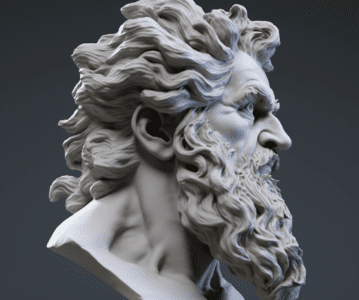
In art and literature, Zeus often appears seated on his throne, exuding authority and power. He is depicted with a flowing beard, a crown, and a thunderbolt in hand. Temples dedicated to Zeus, such as the renowned Temple of Zeus at Olympia, were among the grandest structures in ancient Greece, testaments to the reverence and importance given to this mighty deity.
While Greek mythology has long ceased to be a living belief system, Zeus remains an enduring symbol of power, justice, and the grandeur of ancient Greek civilization. His influence extends beyond the realms of mythology, as his name still echoes in modern scientific terms such as “Zeus Faber” (a species of fish) and “Zeus Ampelos” (a genus of flowering plants). The legacy of Zeus endures, an immortal figure whose stories continue to inspire and captivate generations worldwide.
|
|